


Somatic exercises are gentle, attention-led movements that focus on how your body feels rather than on reps, intensity, or a particular pose. What changes when you notice a movement instead of trying to perfect it? The practice may suit people who want a quiet way to explore stress, tension, and body awareness without a fitness target.
You can try these movements at home with little space and no special equipment. They are not a promise of treatment or trauma recovery. Instead, they offer time to notice sensations such as effort, ease, and changes in your breath. A beginner-friendly routine can help you explore what feels comfortable and what does not.
Some people adapt familiar movements, while others stay still and scan for sensations. Either way, the focus is on curiosity, not doing more or moving farther. You can pause, change the movement, or leave it out if it feels uncomfortable. Begin with a movement that feels comfortable enough to repeat without forcing your range.
Key Takeaways
- Notice sensations instead of chasing a fitness goal.
- Small, comfortable movements are a reasonable place to start.
- Self-guided practice does not guarantee treatment or trauma recovery.
- Stop or adjust a movement that feels uncomfortable.
- Gentle somatic work does not replace general physical activity.
What Are Somatic Exercises and How Do They Work?
A person doing the same simple movement can make it somatic by paying close attention to the sensations it creates. Somatic work uses inward attention to explore how movement feels, while interoception is the ability to notice internal sensations such as breath, warmth, and muscle tension.
The attention you bring to a movement matters more than the movement itself. The Greek word soma means “the body as experienced from within.” Somatic practices developed in the 20th century and draw on that view of the body.
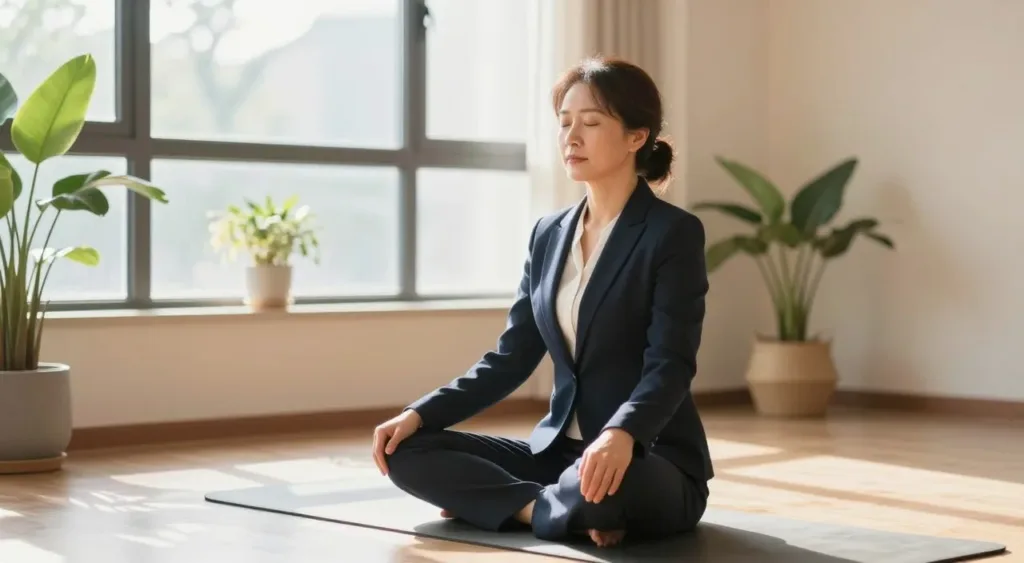
Somatic movement starts with internal attention
What does somatic work? It invites you to notice sensations, body awareness, and shifts in effort as you move or rest. Slow movement and breath awareness can help you explore the mind-body connection without aiming for a perfect shape.
Yoga or Pilates can be practiced somatically when you turn attention inward. You might notice where your body meets the floor, whether one side feels different, or how your breath changes. The same exercise can feel different from one day to another.
Nervous system regulation without a guaranteed reset
The autonomic nervous system has sympathetic and parasympathetic branches, associated with action and rest-and-recovery functions. Noticing sensations while moving slowly may support regulation, but a particular sensation does not prove that your system has shifted.
Cleveland Clinic’s explanation of interoception describes how people sense, interpret, and respond to internal signals. Movement alone does not guarantee a nervous-system reset or cure. Keep the movement small enough to notice each change in breath, effort, or muscle tension.
How Somatic Exercises Differ From Yoga, Pilates, and Dance
A yoga pose becomes somatic when attention shifts from achieving its shape to noticing how it feels. Somatic exercises can use familiar forms of exercise, but their focus is body awareness rather than external performance.
No pose or movement is suitable for everyone. Somatic yoga can use any pose or sequence when sensation matters more than form. Somatic exercises differ from yoga when yoga prioritizes alignment or flow and inward attention is not the main focus.
| Practice | Usual focus | When it is somatic | Example |
|---|---|---|---|
| Yoga | Poses, alignment, or flow | You track sensation over shape | Noticing pressure in a seated pose |
| Pilates | Core control and form | You attend to effort and breath | Feeling the spine during a roll-down |
| Dance | Rhythm or choreography | You follow sensation instead of steps | Moving freely to notice balance |
| Tai chi or qigong | Repeated forms and coordinated motion | You notice weight shifts and ease | Tracking weight through the feet |
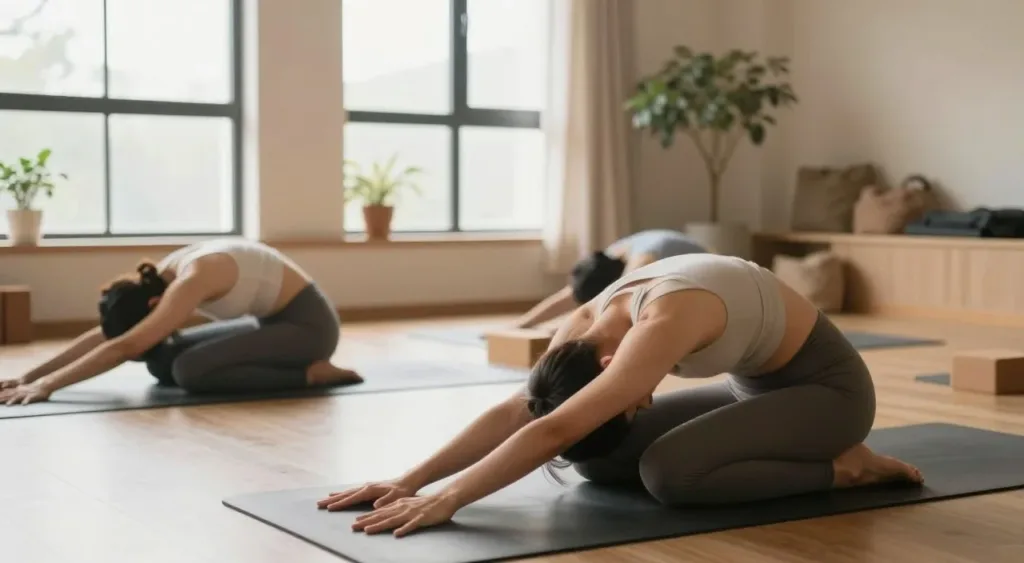
Somatic yoga makes familiar poses inward-focused
Five examples of somatic exercises are corpse pose, child’s pose, seated windshield wiper pose, bridge pose, and cat-cow pose. In corpse pose, scan from the crown of your head to your toes, noticing sensations without judgment.
In bridge pose, hold for four to five breaths, or for five seconds if that is not possible. Skip child’s pose or check with a health care provider if you have knee, heart, or lung issues. Stop seated windshield wipers if they cause hip or knee pain.
Somatic dance follows sensation over choreography
Somatic dance therapy uses movement and body awareness rather than making choreography the sole goal. You can notice how your arms, feet, and balance respond to a simple shift, without learning a set sequence.
Somatic movement may also borrow from tai chi or qigong, where slow, repeated forms can invite attention to weight and coordination. Choose the pose or movement that lets you notice sensation without straining.
A 10-Minute Somatic Workout for Stress at Home
You can try a short somatic routine in a small space with no special equipment. This 10-minute sequence is one practical option, not a required dosage. Keep your eyes open or closed, whichever feels more comfortable.
Set aside three minutes to orient and ground, three minutes for breathing and a body scan, and four minutes for gentle movement and a final check-in. An at-home guide describes 12 exercise types, including grounding, orienting, breathing, shaking, body scans, humming, and pendulation.
Start with orienting and grounding
Stand or sit where you can feel the floor beneath your feet. Notice the room’s colors, shapes, and sounds, then let your attention return to the places your body touches the chair or floor.
Give this phase three minutes. You do not need to change your breathing or find a special feeling. The point is to notice what is present in the room and in your body.
Pair four-count breathing with a body scan
For the next three minutes, try four-count breathing: inhale for a count of four, hold for four, exhale for four, then pause for four. Repeat three to five rounds, or return to your regular breath if counting feels uncomfortable.
Then scan your body from head to feet. Notice areas of warmth, pressure, or muscle tension without grading them. A body scan is observation, not a demand to relax every part.
Add small movements and finish with a check-in
Use the last four minutes for gentle shoulder circles or a small pelvic tilt. Make the movement easy to pause, and notice how your body feels before and after it.
- Choose a stable place to sit or stand.
- Let your gaze move around the room at an easy pace.
- Feel the floor under your feet or the seat beneath you.
- Try a small movement, then notice any change in effort.
- Pause and name one sensation you can feel now.
Some at-home exercise plans use shaking, with the arms, legs, and shoulders moving gently for 30 seconds. You can leave it out if it feels unpleasant. Stop the movement if you feel dizzy or overwhelmed.
Brief home workouts without equipment offer a different way to fit movement into a busy day.
Which Somatic Exercises Help With Anxiety and Tension?
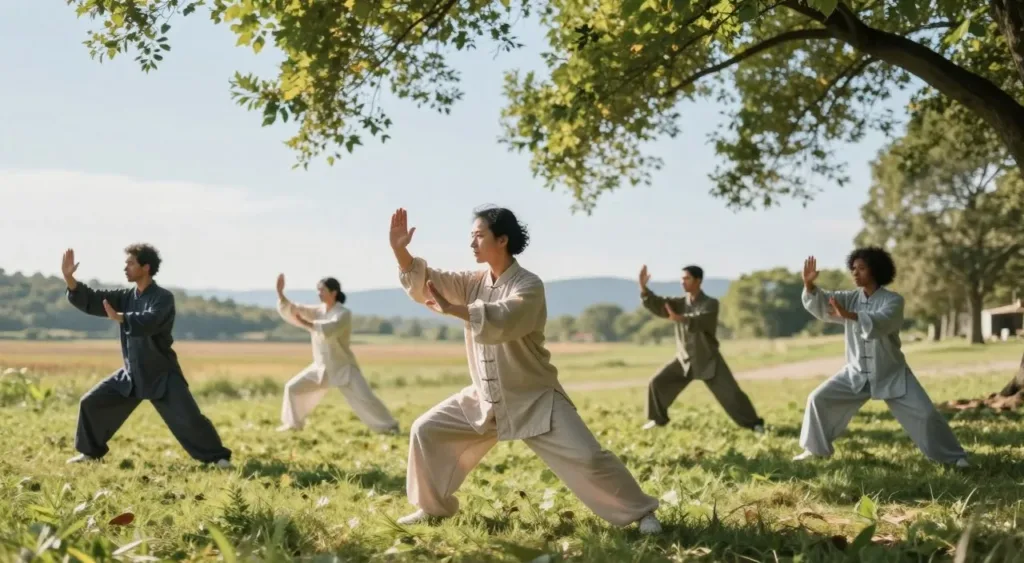
For anxiety, a gentle grounding or Tai Chi practice may be a better starting point than forcing a stretch. No somatic exercise guarantees relief from anxiety or pain. Choose a practice that feels manageable and adjust it to your body.
Somatic exercises for anxiety can include grounding, gentle movement, or Tai Chi, with attention on the body’s response. Somatic exercises for weight loss are not an evidence-based weight-loss method. Somatic exercises to reduce cortisol are not established by the evidence described here.
| Concern | Practice | Attention cue | Adjustment |
|---|---|---|---|
| Anxiety | Grounding or Tai Chi | Notice feet and weight shifts | Keep eyes open and slow down |
| Hip or lower-back tension | Small pelvic tilts | Notice ease across the back | Use a smaller range or stop |
| Shoulder tension | Gentle shoulder circles | Notice effort and shoulder position | Make the circles smaller |
A 2025 systematic review and network meta-analysis included 82 randomized controlled trials with 4,501 adults. It found traditional Chinese exercises, including Tai Chi and qigong, may help manage anxiety and depression, with differences across protocols and populations.
The 2025 analysis of traditional Chinese exercises ranked Tai Chi among the highest-rated interventions for anxiety and depression. Liu Zi Jue ranked highest for anxiety, while Yijinjing ranked second for depression. These rankings do not show that one practice works for everyone.
A 2022 study found that a somatic program using pandiculation, a slow muscle contraction followed by release, reduced lower-back and neck pain. A small study published in June 2025 found that older adults in a twice-weekly, hour-long online somatic movement program moved their spines more easily after 10 weeks.
One study in a 2020 review reported 86% fewer pain days among people with chronic pain who practiced somatic movement regularly for a year. That result came from one study, not a promise of the same outcome for others. Keep the range comfortable and stop or adjust if a movement increases pain.
Somatic Therapy, Trauma, and When to Get Support
Somatic therapy combines attention to bodily experience with a structured therapeutic relationship, and talking may be part of a session. Somatic exercises do not release trauma on demand. Somatic experiences differ from person to person, and a dramatic release is not required.
What sessions include and whether you talk
A somatic therapy session may include an initial conversation and goal-setting, body-awareness exercises, gentle movement or physical techniques, and time for integration and reflection. Sessions typically last around 50 minutes.
Do you talk during somatic therapy? Yes, talking can accompany attention to bodily sensations and help shape the work. There is no universally accepted list of exactly three somatic therapy types; approaches differ by method and training.
What does a somatic release feel like? Experiences vary, and you might notice a small shift in tension, emotion, or breath, or no dramatic change. Somatic exercises to release trauma are not a guaranteed or on-demand treatment.
At-home practice, safety, and therapist training
Downsides of somatic therapy can include distress when body-focused attention brings up difficult feelings. Seek a licensed mental health professional if you experience:
- Flashbacks or dissociation
- Overwhelming feelings during practice
- Complex trauma that needs careful support
- Distress that continues after practice
Training to become a somatic therapist depends on the method and professional credentials. Somatic Experiencing International’s professional training takes 6-8 sequential modules over 2½ to 3 years, with each module lasting four to six days.
Its Basic Principles course lasts three hours. For somatic exercises near you, check a provider’s relevant training, credentials, and experience with your needs. If body-focused practice brings up overwhelming distress, pause and seek support from a licensed mental health professional.
Build a Simple Daily Practice You Can Sustain
A sustainable practice can be brief, regular, and tied to a routine you already have. One suggested somatic routine is 15 to 30 minutes a day, but that duration is a suggestion, not a requirement.
Gentle somatic movement does not automatically count as moderate aerobic or muscle-strengthening activity. U.S. adults are generally advised to get at least 150 minutes of moderate-intensity aerobic activity each week, plus muscle-strengthening activity on two days.
Try one of these habit anchors:
- Practice after making coffee.
- Take a movement break after sitting.
- Set aside a few minutes before bed.
- Pair a body check-in with a daily transition.
Small daily health habits can make a new routine easier to keep. For aerobic goals, steady Zone 2 cardio is a separate kind of movement. Choose a duration and habit cue that you can repeat comfortably.
Conclusion
Somatic exercises begin with noticing, not pushing for a bigger movement or a dramatic result. Attention to how your body feels matters more than performing a movement perfectly.
A small, comfortable practice is a reasonable starting point when you want to explore movement and stress without turning it into another performance goal. Your sensations may change from one day to the next, and you can adjust the practice to match your comfort.
Choose one simple movement that feels manageable, then pause long enough to notice your response. Try one gentle movement today and note how your body feels before and after.