
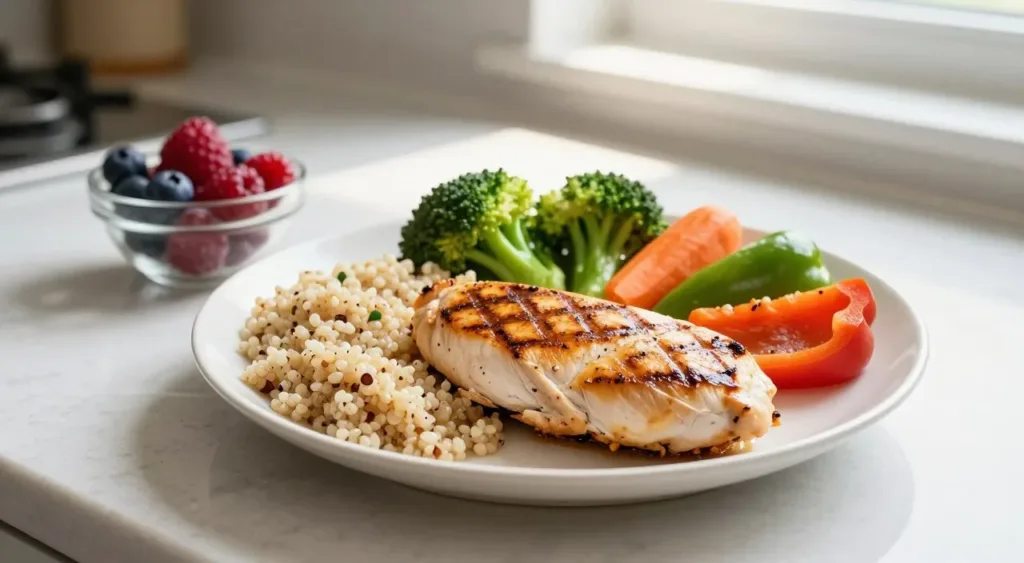

A GLP-1 nutrition plan should prioritize protein, varied nutrient-dense foods, fluids, and strength-focused activity rather than simply eating as little as possible. Could eating less leave you with less strength, too? This GLP-1 nutrition guide offers practical ways to support your health while medication changes your appetite.
Semaglutide and tirzepatide are examples of medications you may encounter. The goal is to support muscle retention and nutrition, not to guarantee that all muscle loss can be prevented. Your eating habits and activity can help, even when your appetite feels different.
Keep these priorities in view as you plan your meals and activity:
- Include protein regularly throughout the day.
- Choose varied foods that provide nutrients in manageable portions.
- Drink fluids consistently, especially when you eat less.
- Use strength-focused activity to support muscle function.
- Ask your care team for help if symptoms make eating difficult.
Treat nutrition as part of medication care, not as a contest to see how little you can eat.
How GLP-1 Weight Loss Affects Muscle

Weight loss on GLP-1 medication can include both fat and lean tissue, so the scale alone does not show what kind of weight is changing. Lean soft tissue means nonfat soft tissue measured by body-composition scans, including muscle and other tissues. It is not the same as skeletal muscle.
Body-composition results show that some lean soft tissue may be lost during weight reduction. In 2025 reports, the STEP 1 semaglutide DXA subgroup lost 6.9 kg of lean soft tissue and 10.4 kg of fat mass. Lean soft tissue accounted for about 40% of the weight loss.
What body-composition studies show
In the SURMOUNT-1 tirzepatide DXA subgroup, participants lost 5.6 kg of lean soft tissue and 15.9 kg of fat mass. That was about 26% of their weight loss. These findings describe group averages, not a guaranteed result for you.
Weight loss can also differ by medication and dose. The table shows mean body-weight changes in separate trials, each with its own participants and study conditions.
| Medication and dose | Trial duration | Mean body-weight change |
|---|---|---|
| Semaglutide 2.4 mg | 68 weeks | -14.9% |
| Tirzepatide 5 mg | 72 weeks | -15.0% |
| Tirzepatide 10 mg | 72 weeks | -19.5% |
| Tirzepatide 15 mg | 72 weeks | -20.9% |
| Retatrutide 12 mg | 80 weeks | -25.0% |
Why trial averages are not a personal forecast
STEP 1 found a mean body-weight reduction of 14.9% with semaglutide 2.4 mg weekly plus lifestyle intervention over 68 weeks. In SURMOUNT-1, tirzepatide doses of 5, 10, and 15 mg weekly produced mean changes of -15.0%, -19.5%, and -20.9% over 72 weeks. Its lifestyle program included a 500-calorie daily deficit and at least 150 minutes of weekly activity.
A 2026 phase 3 trial found mean changes of -17.6%, -23.7%, and -25.0% with retatrutide doses of 4, 9, and 12 mg over 80 weeks, compared with -3.9% for placebo. The SURMOUNT-1 trial also reported the tirzepatide results. These are separate trials, not a head-to-head comparison. Retatrutide 12 mg had the largest mean reduction among these results, but that does not establish an overall medication winner.
A 20-pound loss has no trial-backed guaranteed timetable. Starting weight, medication and dose, titration, and individual response affect when you reach that amount. Use trial percentages as context, not as a prediction of an individual’s results.
How Much Protein Should a GLP-1 Nutrition Guide Recommend?

A practical starting target is about 1.2 grams of protein per kilogram of body weight each day, with your clinician or registered dietitian adjusting it for your needs. For a 150-pound person, that works out to about 82 grams daily. This is practical guidance, not an individualized prescription.
If you consistently eat too little protein during weight loss, you may have less support for maintaining lean tissue. The risk of muscle loss is not determined by protein alone, and your needs can change with your health and treatment.
Set a daily protein target
A 2025 study of 40 adults with obesity included 23 people prescribed semaglutide and 17 in a diet-and-lifestyle program. A similar share of weight loss came from lean mass in both groups. In the semaglutide group, older age, female sex, and lower protein intake were associated with greater muscle loss after accounting for weight loss.
A 2025 case series of three patients reported protein intakes of 0.7-1.7 g/kg of body weight daily and 1.6-2.3 g/kg of fat-free mass daily. Two patients increased lean soft tissue by 2.5% and 5.8%, while the third lost 6.9%. These preliminary examples do not prove that a particular intake prevents muscle loss.
Distribute protein across small eating occasions
Aim for roughly 20-30 grams of protein at a main meal when that feels manageable. If solid food is difficult, a protein shake can be an option, not a requirement. Whey, soy, and pea are common shake choices; supplements do not replace a varied diet.
Semaglutide is the ingredient in Ozempic and Wegovy, while tirzepatide is the ingredient in Mounjaro. Brand names and prescribed uses can differ. If appetite makes it hard to meet a protein goal, ask your care team for a workable plan instead of forcing large meals.
Choose Nutrient-Dense Foods for GLP-1 Treatment
When appetite is reduced, choose foods that deliver protein, fiber, and other nutrients in a manageable portion. Build meals around a few nutrient-dense options that feel comfortable to eat. No single menu suits everyone, and these choices are suggestions rather than a required or exhaustive list.
- Protein foods: eggs, fish, Greek yogurt, tofu, and beans.
- Fiber-rich foods: oats, berries, leafy greens, and lentils.
- Fruits and vegetables: apples, tomatoes, broccoli, and carrots.
Other choices include cottage cheese, chicken, salmon, sardines, tuna, quinoa, farro, zucchini, and whole grains. A smaller appetite may make a full plate feel like too much, so combining a few items in a modest serving can be more practical.
Coffee is not a dependable way to increase the effect of a prescribed GLP-1 medication. Coffee may affect the body’s own GLP-1, but that is different from the effects of medication. Consider your personal tolerance, including whether coffee worsens stomach symptoms.
Keep a few convenient options, such as Greek yogurt, eggs, or beans, available for days when cooking feels difficult.
Build a Simple Meal Plan for Weight Loss and Muscle Retention
A simple starting pattern is three smaller meals with nourishing snacks, or five or six small balanced eating occasions if that feels more manageable. Pairing a protein with fruit or a vegetable and a whole-grain starch can make a small meal more balanced.
UCHealth dietitians suggest three smaller meals with healthy snacks or five or six small eating occasions daily. Use the sample day as a flexible starting point, not a fixed schedule.
| Eating occasion | Sample meal or snack | Nutrition focus |
|---|---|---|
| Breakfast | Greek yogurt with berries and oats | Protein plus fruit and whole grain |
| Lunch | Chicken or tofu with leafy greens and a whole-grain starch | Protein plus vegetables and grain |
| Snack | Cottage cheese with fruit or a protein shake | A small protein-rich option |
| Dinner | Fish with cooked vegetables and a moderate portion of rice or another grain | Protein plus vegetables and starch |
Adjust portions and meal timing to your appetite and clinical needs rather than treating the table as a prescription. Calories and nutrition needs differ, so a registered dietitian can help adapt meals if you are unsure how much feels appropriate.
For retatrutide, use the same broad foundation of protein, varied nutrients, fluids, and activity. A prescriber or registered dietitian can tailor food choices and amounts to your needs. For another flexible approach to planning, try this beginner meal-planning guide, but discuss major diet changes with your care team.
If a full meal feels unmanageable, choose a small balanced snack rather than skipping food for the rest of the day.
Manage Nausea, Constipation, and Low Appetite
Smaller portions, slower eating, and steady sips of fluid can make meals easier when nausea or early fullness appears. Contact your prescriber if vomiting persists, constipation becomes severe, or you cannot maintain enough food or fluid. Medication changes belong to your clinician.
Nausea, diarrhea, and constipation can occur, often during treatment initiation or dose escalation. In STEP 1, nausea and diarrhea were the most common adverse events and were typically transient and mild to moderate. Tirzepatide gastrointestinal events occurred mainly during dose escalation and were mostly mild to moderate.
Make eating easier when nausea or fullness hits
Eat slowly because the brain takes about 20 minutes to recognize the full extent of a meal. Sip water or another drink through the day; UCHealth dietitians recommend 8-10 glasses of water or sugar-free beverages daily. Ginger tea is another option when nausea affects your appetite.
Smaller servings can help when you feel full quickly. If a symptom continues or affects your ability to eat, tell your care team rather than changing your medication on your own.
Support regularity with fiber, fluids, and activity
Fiber can support constipation relief, but increase it gradually according to your tolerance and pair it with fluids. General fiber benchmarks are 25 g daily for women and 35 g daily for men. A walk can also help with constipation when you feel able to move.
A 2025 nutrition review recommends adequate macronutrient, micronutrient, and fluid intake, physical activity, and healthcare-professional monitoring. The expert consensus statement also supports individualized nutrition and lifestyle care. Reduced food intake can make micronutrient adequacy and professional monitoring more important.
Small-particle, low-fat foods are a symptom-relief approach for people with gastroparesis, not a universal diet. Discuss that approach with a clinician if gastroparesis is present. Contact your prescriber if vomiting persists, constipation becomes severe, or you cannot maintain enough food or fluid.
What Not to Eat on GLP-1?
No single food is automatically off-limits for everyone, but high-fat, greasy meals and some sugary or heavily processed foods can make symptoms harder to manage. Limit foods that trigger your symptoms or regularly displace more nourishing choices.
While adjusting to a GLP-1 medication, consider limiting these foods or drinks if they cause trouble:
- Greasy or fried foods, including fast food.
- High-fat meals, such as pizza or fried chicken.
- Added-sugar foods and drinks, including soda, juice, candy, and desserts.
- Refined carbohydrates and ultra-processed snacks.
- Alcohol.
Spicy foods, such as hot sauce and hot peppers, may also be harder for some people to tolerate. These are possible symptom triggers, not rules that every person needs to follow.
Eating sugar once while taking semaglutide does not cancel the medication. Frequent sugary choices can crowd out nutrient-dense foods and may affect blood sugar, especially if you also use diabetes medication. A single food choice does not tell you how your overall dietary habits affect health.
Notice which foods precede symptoms and discuss persistent problems with your care team. Use your own symptom pattern, rather than a universal banned-food list, to decide what to limit.
Conclusion
Small, consistent nutrition and activity habits can support your health while your medication helps manage weight. Regular protein, balanced meals, fluids, and resistance activity can support your body during weight loss, though they cannot promise a specific body-composition result.
Your prescriber or a registered dietitian can personalize protein and meal goals, especially if appetite suppression or symptoms interfere with eating. Bring your current eating pattern and any difficult symptoms to your next appointment and ask for a plan tailored to you.