


A steady workout you can repeat next week can be a better starting point than an all-out session that leaves you depleted. Zone 2 cardio is an effort level, not a particular exercise, so you can shape it around your fitness, health, and goals. LT1 is the first lactate threshold, the point at which blood lactate begins to rise above resting levels.
You can begin without expensive equipment or a punishing workout. A practical routine should feel manageable enough to return to, even during a busy week. The aim is to build endurance through steady activity that fits your life, not to chase a perfect number or prove how hard you can push.
Key Takeaways
- Choose an effort you can sustain and repeat.
- Use conversation as a practical guide to effort.
- A heart-rate estimate is a starting point, not a personal measurement.
- Step totals track movement, while effort shows workout intensity.
- Build your weekly activity gradually and include strength work.
Choose a pace you can imagine fitting into an ordinary week, not just an unusually motivated one.
Zone 2 Cardio: What Should It Feel Like?
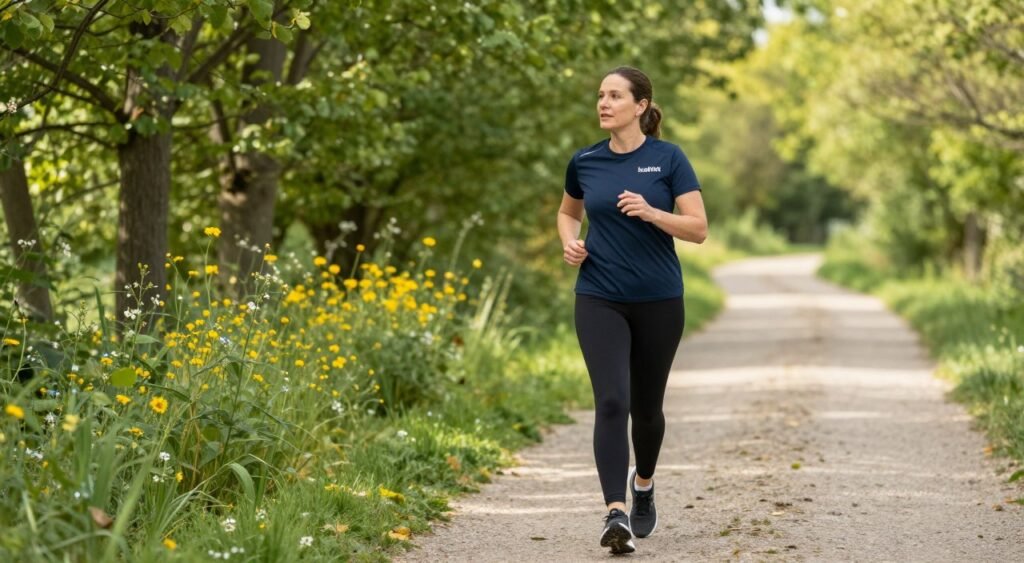
At a steady Zone 2 effort, you can speak in full sentences while your breathing is clearly more active than at rest. The pace feels controlled, not effortless, and the five-zone model places Zone 2 near the low end of its intensity scale.
Zone 2 is commonly described as low-intensity exercise below the lactate threshold. Your breathing grows deeper and faster, but you can still hold a comfortable conversation without pausing after every few words.
LT1 marks the point where blood lactate begins rising above resting levels. The first ventilatory threshold, or VT1, is a related breathing marker used to describe a shift in exercise intensity. These thresholds help explain the training zone, but you do not need a lab test to make a useful everyday effort check.
That check is useful because people respond differently to the same pace. Singing should feel difficult at this effort. If you are gasping or can manage only a few words, ease off rather than trying to hold the pace.
Very easy recovery movement feels more relaxed than this steady aerobic work. Hard intervals sit at the other end: breathing gets sharp, conversation becomes difficult, and you need recovery periods between efforts.
Think of the goal as a steady effort that supports your aerobic base without turning every workout into a test. If conversation breaks into short phrases, reduce your effort until a full sentence feels comfortable again.
How Can You Find Your Zone 2 Heart Rate?

For a quick starting range, estimate maximum heart rate by age, then calculate 60% and 70% of that number. A common estimate places Zone 2 at 60%-70% of estimated maximum heart rate, though the result is only a guide.
One age-based equation estimates maximum heart rate as 207 minus 0.7 multiplied by your age. For example, at age 40, the estimate is 179 beats per minute; multiplying by 0.60 and 0.70 gives a range of about 107-125 beats per minute.
A Zone 2 cardio heart rate calculator uses an age-based maximum-heart-rate estimate and the 60%-70% range. Zone 2 cardio heart rate by age is a starting estimate rather than an individual measurement, because predicted maximum heart rate can differ from your actual maximum.
In a study of 26 adults aged 18 to 25, exercise heart rates were in the intended zone 82% of the time when zones used predicted maximum heart rate. The age-based prediction equation used 207 – 0.7 × age, with a standard deviation of ±5 to 8 beats per minute. Measured maximum heart rate was above the predicted value for 54% of participants and below it for 46%.
A wearable monitor can show your rate, but its zone labels still depend on the settings and estimate it uses. Individual variation matters: in a laboratory study of 50 experienced cyclists, variation across Zone 2 markers ranged from 6% to 29%.
| Method | What it uses | Practical strength | Main limitation |
|---|---|---|---|
| Estimated maximum heart rate | Age-based equation and percentage range | Quick estimate without lab equipment | Predicted maximum may differ from yours |
| Talk test | Breathing and comfortable speech | Available during any workout | Not an exact laboratory measurement |
| Laboratory VT1 or FatMax assessment | Measured breathing or fat oxidation | More personalized prescription | Requires a laboratory assessment |
VT1 means the first ventilatory threshold, while FatMax identifies the exercise intensity at which fat oxidation is highest. A laboratory assessment using VT1 or FatMax can personalize training for athletes who need greater precision. Recheck the talk test whenever a device reading conflicts with how hard the effort feels.
Which Activities Count as Zone 2?

Brisk walking is the simplest no-equipment option, but the right pace depends on whether you can still talk comfortably. The activity counts when its effort matches that conversational range, not simply because it appears on a workout list.
Five options can fit the zone, depending on how you do them:
- Brisk outdoor walking
- Treadmill walking with adjustable speed or incline
- Easy cycling
- Steady swimming
- Rowing or elliptical work
Walking can be Zone 2 when the pace is brisk enough to raise your breathing while leaving conversation comfortable. A casual stroll may be easier than that. Zone 2 cardio examples with no equipment include brisk outdoor walking and marching in place, while a stationary bike can work at home if you have one.
For Zone 2 cardio exercises at home, walk around a safe indoor route, march in place at a steady pace, or ride a stationary bike. Adjust your pace until your breathing and speech fit the intended effort. The room, equipment, and movement pattern matter less than the intensity you reach.
Walking 10,000 steps a day, about five miles, is described as safe for most people, but that total is not automatically a cardio workout. It counts as cardio when your pace and effort reach a meaningful intensity. A step counter cannot show how hard each step felt.
A treadmill MET guide classifies 3.0-5.9 METs as moderate activity and 6.0 METs or greater as vigorous activity. Walking speed and incline can change the demand, so the same treadmill setting will not feel identical for everyone.
A 2023 meta-analysis included 17 cohort studies with 226,889 participants and a median follow-up of 7.1 years. Each additional 1,000 daily steps was associated with a 15% lower risk of all-cause mortality, while each additional 500 steps was associated with a 7% lower risk of cardiovascular mortality.
Daily step counts above approximately 5,500 were associated with sharply lower relative risks of all-cause mortality across the climate zones studied. A 2025 review found that 7,000 steps per day was associated with a 47% lower mortality risk than 2,000 steps per day. These are associations, not proof that a specific total causes a particular health outcome. Use step totals to track movement, then use effort to decide whether a walk was a Zone 2 session.
How Much Cardio Should You Do Each Week?
Two or three manageable sessions are a practical starting rhythm, and each session can contribute to your weekly activity total. A 20-minute walk counts as cardio when it reaches moderate intensity, and shorter bouts still add to your weekly minutes.
U.S. adult activity guidance calls for at least 150 minutes of moderate-intensity activity or 75 minutes of vigorous activity per week. Your steady sessions can contribute toward that broader target, alongside other movement in your routine.
You do not have to discard a walk because it lasts less than a full workout. Short bouts accumulate, which can make it easier to find time around work, family, or other commitments. Count activity that reaches the relevant intensity rather than judging a session by its label.
| Weekly option | Sessions | Minutes per session | Weekly minutes |
|---|---|---|---|
| 2 sessions | 2 | 30 minutes each | 60 minutes |
| 3 sessions | 3 | 30 minutes each | 90 minutes |
| 3 sessions | 3 | 50 minutes each | 150 minutes |
The table shows how a few different schedules add up. The 150-minute option reaches the weekly moderate-activity target if the sessions meet moderate intensity. If you are starting with less activity, smaller sessions can still establish a routine and build toward more time.
Twenty thousand steps a day is not automatically too much, but whether that volume suits you depends on your starting activity, pace, recovery, and symptoms. A sudden jump to a large new volume can be hard to recover from. Add minutes or steps gradually, rather than changing everything at once.
Keep your plan realistic when your calendar gets crowded. A schedule you can maintain is more useful than a demanding target that repeatedly falls apart. Add time in small increments and keep the schedule sustainable before increasing its weekly volume.
What Benefits Does Zone 2 Offer, and What Are Its Limits?
Zone 2 can make steady aerobic work easier to repeat, but it is not proven to outperform harder training for every adaptation. It offers one sustainable way to accumulate aerobic activity and build endurance, without a special promise about fat loss or mitochondria.
A 2025 narrative review found no substantive evidence that Zone 2 training is superior to higher exercise intensities for improving mitochondrial or fat-oxidative capacity. The same review concluded that higher exercise intensities may matter for maximizing cardiometabolic health benefits, particularly when training volume is low.
Zone 2 may also fall below the moderate-to-vigorous intensity range recommended by physical-activity guidelines. That does not make it useless. It means you should consider your broader fitness goals instead of treating one training zone as the answer to every goal.
Zone 2 and Zone 3 do not guarantee fat loss. Changes in body weight depend more on adherence and overall energy balance than on a zone label, so neither intensity can promise a particular result on its own.
Your body can adapt to a familiar pace. As fitness improves, the same speed or resistance may feel easier, and maintaining the same perceived effort may require a faster pace or greater resistance.
Walking 10,000 steps a day for 30 days can help you build a consistent activity habit. It cannot promise an individual change in weight, fitness, or health, since outcomes differ from person to person.
Steady work can be a useful part of training, especially when it feels manageable enough to repeat. It is one tool among several, not a shortcut that replaces all other forms of exercise. When training time is limited, include some effort above Zone 2 if your health and fitness allow it.
How Do You Fit It Into a Balanced Week?
A balanced week can pair steady cardio with strength sessions instead of making every workout hard. U.S. physical activity guidance recommends muscle-strengthening activity on at least 2 days per week, so leave room for it alongside your cardio.
A treadmill walking workout can use a 5-8 minute easy warm-up, 20-40 minutes at a steady conversational effort, and a 3-5 minute cool-down. Adjust the speed or incline gradually rather than making a large jump.
Use these checks to keep your workout practical:
- Leave room in your week for strength work.
- Choose a pace or incline that passes the talk test.
- Adjust treadmill speed or incline gradually.
- Stop or ease off if unusual symptoms appear.
Those symptoms deserve more attention than a workout target. Chest pain, faintness, or unusual shortness of breath should not be treated as ordinary training discomfort.
Conclusion
A useful Zone 2 routine starts with an effort you can repeat, not a perfect number on a watch. A comfortable conversational pace and a schedule that fits your life are better starting points than chasing a precise heart-rate reading.
You do not need to solve every part of your fitness routine before beginning. Pick one activity, keep the effort steady, and notice whether it feels manageable enough to return to. That first workout gives you a practical starting point for building endurance and making cardio part of your health routine.
Choose one activity for your next workout and let the talk test set the pace.