


A HYROX race challenges you to keep running well while performing functional work under fatigue. For first-time athletes, preparing for race day means building fitness through running, strength practice, and recovery, not trying to master everything at once. You can start with basic fitness and gradually add race-specific work as your body adapts.
This guide gives you practical ways to prepare without treating every workout like a full event. A steady, progressive routine is a more useful starting point than trying to imitate an entire race on day one.
Key Takeaways
- Build running endurance alongside functional strength.
- Practice movements and transitions before full simulations.
- Adjust training loads to your division and season.
- Use recovery days to support steady progress.
- Start with workouts you can complete with good form.
What Makes HYROX Training Feel So Demanding?
HYROX is an indoor fitness race built around eight 1 km runs, each followed by a functional station. Singles athletes repeat that pattern eight times, completing 8 km of running and eight stations in a fixed order. The Roxzone is the transition area between the running course and workout stations.
Every run and station must be completed in order for a valid finishing time. That global format stays consistent across events, which makes training and progress easier to compare. Races take place indoors in exhibition halls, where turns, noise, and crowds can add pressure.

The HYROX workout benefits include aerobic endurance, functional strength, muscular endurance, and a standardized way to measure progress. A 2025 study of 11 HYROX athletes reported an average of 51 minutes running and 33 minutes at stations. That split shows why running deserves serious attention.
A HYROX workout in English is a race workout that alternates running with functional stations, rather than one long run or a strength-only session. Athletes must manage effort as fatigue builds. Starting too hard can make later running and movement control much more difficult.
Training should prepare you to run after demanding work, not only when your legs feel fresh. A run immediately after functional work is a compromised run, and practicing it helps you adjust to that change in effort. Treat consistent running as a core part of preparation because the race spends a substantial share of its time on foot.
What Happens at Each of the Eight HYROX Stations?
The station sequence starts with the SkiErg and ends with 100 wall-ball reps. The eight exercises are commonly called stations, and each has a distinct job: some test leg power, while others challenge grip, trunk control, or overhead endurance.
In 2026/27 Singles, the fixed order is four opening stations followed by four more. The HYROX workout list gives you the full sequence, while this plain-English breakdown explains what each movement asks of you.
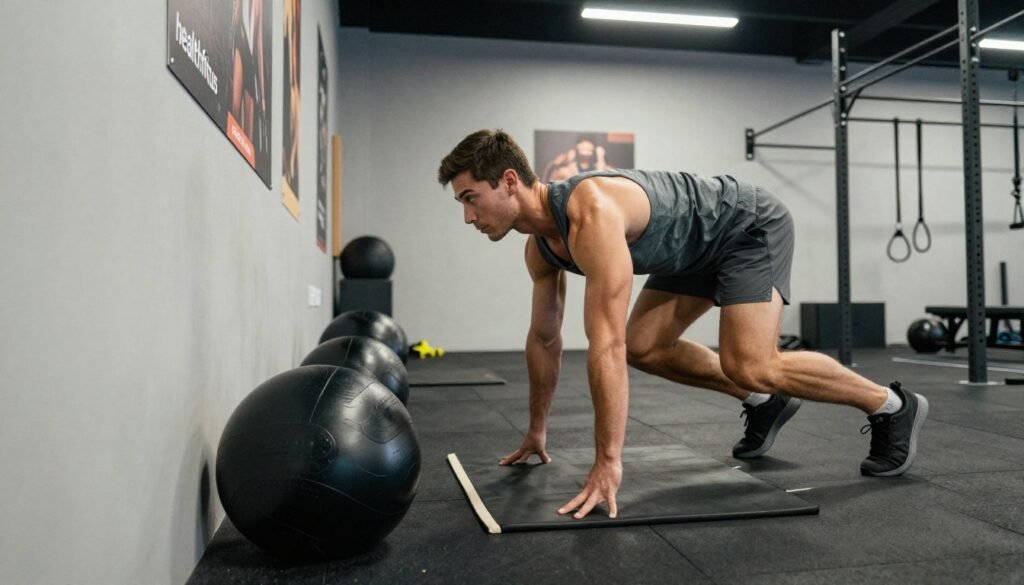
The First Four Stations Build Heat and Leg Fatigue
The order matters: you complete each station before moving on to its following run. These first four shifts move from machine work to heavy sleds and repeated floor-to-standing movement.
- SkiErg: Pull the handles down and back to cover 1,000 m, using your arms, trunk, and hips.
- Sled push: Drive a loaded sled forward with short, forceful steps that tax your legs and breathing.
- Sled pull: Move the sled toward you with a rope, using leg drive, bracing, and grip strength.
- Burpee broad jumps: Cover 80 m by lowering to the floor, standing, then jumping forward repeatedly.
The Final Four Stations Test Endurance Under Fatigue
These movements arrive after substantial running and earlier station work. The rowing distance is 1,000 m in every Singles division, and the last station calls for repeated throws.
- Rowing: Complete 1,000 m with repeated leg drive and controlled pulls on the handle.
- Kettlebell farmers carry: Walk while holding weights at your sides, keeping your posture tall and grip steady.
- Sandbag lunge: Carry the bag while stepping into repeated lunges, which demand balance and leg endurance.
- Wall balls: Squat with a medicine ball, then throw it to the target for 100 reps.
| Station | Distance or reps | Main physical demand | Useful practice focus |
|---|---|---|---|
| SkiErg | 1,000 m | Trunk and arm endurance | Even strokes |
| Sled push | Four 12.5 m lengths | Leg power | Short driving steps |
| Sled pull | Four 12.5 m lengths | Grip and bracing | Steady rope pulls |
| Burpee broad jumps | 80 m | Full-body endurance | Repeatable jump length |
| Wall balls | 100 reps | Leg and shoulder endurance | Consistent squat and throw |
Keep the distinction between a station’s movement and its sequence clear. Burpee broad jumps are not simply broad jumps, since each jump follows a burpee. Memorize the order before training combinations so each practice session reflects the race sequence.
Which HYROX Division and Weights Should You Train For?
Singles has four categories, and the appropriate load depends on both your category and the season’s rulebook. The 2026/27 Singles divisions are Women, Women Pro, Men, and Men Pro.
Racers must be at least 16 on race day. Age groups run in five-year increments, from Under 24, which includes ages 16-24, through ages 85-89. The women’s division is not one universal load: Women and Women Pro differ at the sleds and wall-ball target.

Choose a Singles Division That Matches Your Experience
Open and Pro are separate Singles categories, so choose the one that fits your experience and current ability. Use the listed weights as race standards, not as a demand to train heavy every session.
Check the Loads for Your Division
Sled weights below include the sled itself. Each sled push and sled pull covers four 12.5 m lengths.
| Division | Sled push | Sled pull | Farmers carry |
|---|---|---|---|
| Women | 102 kg | 78 kg | 2 x 16 kg |
| Women Pro | 152 kg | 103 kg | 2 x 24 kg |
| Men | 152 kg | 103 kg | 2 x 24 kg |
| Men Pro | 202 kg | 153 kg | 2 x 32 kg |
The 2026/27 farmers carry is 200 m. Sandbag lunges cover 100 m: Women use 10 kg, Men and Women Pro use 20 kg, and Men Pro use 30 kg. Wall balls require 100 reps. Women use a 4 kg ball, Men and Women Pro use 6 kg, and Men Pro use 9 kg.
Women and Women Pro throw to a 2.70 m target; Men and Men Pro throw to a 3.00 m target. Doubles partners run each 1 km segment together and may split stations. In Relay, each athlete completes two 1 km runs and their corresponding two stations. Confirm the division and current season’s load standards before building heavy sled or wall-ball practice.
How Should You Build a HYROX Training Plan?
A useful HYROX plan builds consistent running and strength before adding frequent race simulations. Beginners often plan over 8-12 weeks, while a 12-week structure gives time to improve fitness without rushing every skill.
Keep running and strength work in the plan throughout all three four-week blocks. An 8-week option can suit people who already train regularly, but it still needs recovery and a gradual increase in race-specific work.
Build a 12-Week Base and Add Race-Specific Work
Use weeks 1-4 to build an aerobic base, then weeks 5-8 to add intensity and run-station combinations. Weeks 9-11 can include race simulations, with week 12 set aside to taper. The plan can also include grip strengthening and recovery work.
A 5 km Zone 2 run should feel moderate enough for a conversation. Around 50% of HYROX race time is spent running, so easy miles help develop endurance without making every run a hard test. In a 2025 study, higher VO₂max and greater endurance-training volume strongly correlated with faster finish times.
Set Weekly Running and Strength Sessions
Choose a weekly pattern that matches your running background, then add strength work without crowding out rest.
| Level | Runs per week | Suggested run types | Strength sessions |
|---|---|---|---|
| Beginner | 2 | Intervals and long run | 2-3 |
| Intermediate | 3 | Intervals, tempo, long run | 2-3 |
| Advanced | 3-4 | Intervals and tempo emphasis | 2-3 |
Progress Work While Protecting Recovery
Increase training volume gradually, and keep easy days easy. Include a mix of aerobic work, strength, and movement practice rather than stacking hard sessions back-to-back.
- Easy aerobic running builds a base you can recover from.
- Quality running develops speed without replacing every easy run.
- Strength work supports control under load and repeated movement.
- Compromised-run practice helps you run after functional work.
- Recovery gives your body time to adapt to training.
Record each session, including effort and how you felt afterward. That simple note can show when to add work or repeat a week. Keep at least one full rest day in the week rather than turning every session into a test.
What Does a HYROX Workout Look Like?
A race-specific workout pairs manageable strength work with stations performed after your heart rate has risen. Keep the goal specific: build useful strength, then practice moving well when breathing becomes harder.
These examples are training sessions, not a full race simulation. Scale the load or reps so your technique stays controlled, especially when you are learning a movement or returning after time away.
Combine Strength Work With Sustainable Conditioning
One strength session could include back squats for 4 x 6-8 reps and overhead presses for 4 x 8 reps. Choose a load that lets you keep a steady brace, smooth range of motion, and safe control through each set.
For a separate conditioning workout, row 500 m, complete 20 wall balls, and do 20 lunges. Rest for 2 minutes, then repeat the full sequence four times. Reduce the ball weight or lunge depth if your form starts to break down.
The rowing gives you steady machine work, while the wall balls and lunges test leg endurance and overhead control. Leave enough energy to repeat the same quality on later rounds. You should not need to sprint the first round to finish the session.
Practice Run-to-Station Transitions
To rehearse transitions, run a manageable segment, move directly into one station, then recover before the next effort. For example, use a comfortable run followed by a short set of lunges. The point is to notice how your legs and breathing feel when you start the station.
Start with one transition and add another only when the first feels repeatable. Keep the run controlled and make the station short enough to maintain clean movement. This kind of workout helps you learn effort changes without copying the race from start to finish.
Make the session easier by shortening the run, reducing reps, or using lighter equipment. Make it harder only when your technique stays steady across all rounds. Finish the session while your movement quality is still controlled instead of turning every practice into an all-out test.
How Can Beginners Train Without Race Equipment?
You can begin building movement control and conditioning at home before you have access to a sled or erg machine. Bodyweight work is a useful start when you have a clear floor and enough room to move safely.
Bodyweight sessions build coordination and muscular endurance, but they cannot reproduce heavy sled resistance. They also cannot teach SkiErg or rowing technique, or fully copy loaded carries.
Use Bodyweight Movements to Build Basic Capacity
Try one circuit of 60 seconds of high knees and 15 squat jumps, repeated for four rounds with 30 seconds of rest. Another option is four rounds of 10 burpee broad jumps, 12 alternating reverse lunges, and 8 plank walkouts, with 30 seconds of rest.
A short finisher can be a 4-minute AMRAP: complete 10 mountain climbers, 5 burpees, and 10 alternating jump lunges, then repeat at a steady pace until time ends. Skip jumps or shorten the range if they cause pain.
Know Which Skills Need Real Equipment
Practice the movement pattern first, then use a gym session to learn equipment-specific skills when you can. A coach or gym staff member can show you safe setup and technique on a sled, rower, or SkiErg.
These circuits are starting options, not official race substitutes. Adjust the movements to your current fitness and stop if form slips. Treat bodyweight sessions as preparation for specific race skills, not as a replacement for practicing the equipment itself.
How Can You Pace the Race and Recover Well?
A conservative first run gives you more room to maintain form through later stations. Start at a sustainable effort rather than trying to bank time before fatigue builds.
Efficient transitions mean moving with purpose, not rushing your technique. Practice crossing the Roxzone smoothly, and relax your hands between grip-heavy stations when you can. Keep moving, but avoid squeezing equipment harder than the task requires.
Keep Early Efforts Controlled and Transitions Efficient
Choose a running effort that lets you settle into a repeatable rhythm. Your heart rate will rise during hard stations, so ease back briefly if needed before returning to your usual pace. A compromised run can feel awkward at first; practice helps you avoid reacting with an all-out surge.
During carries and pulls, keep your grip firm enough to hold securely, then loosen your hands during easier moments. Walk with control through transitions and find the correct entry without wasting time. A calm change of task often saves more energy than a hurried one.
Plan Food, Hydration, and Recovery
A general race-day meal can fit 3-4 hours before your start. An optional carbohydrate-focused snack 60-90 minutes beforehand may work for you, but test the timing during training. Avoid unfamiliar foods on race day.
Drink according to your needs and the event’s instructions. Recovery habits matter between workouts, too: general guidance includes a full rest day each week and 7-9 hours of sleep. Use those as practical targets, not a reason to ignore how you feel.
- Pack familiar food that you have tested before training.
- Set out comfortable shoes you have already worn for runs.
- Plan hydration around the event’s instructions.
- Check your bib or registration details before leaving.
- Choose a warm-up plan you have practiced.
Use only familiar food and drink on race day, and follow the event’s own instructions for hydration and equipment.
How Does HYROX Compare With CrossFit and a Marathon?
HYROX is a fixed-format race, while CrossFit workouts can change from day to day. HYROX is not basically CrossFit, even though both use functional fitness and can challenge strength and conditioning.
HYROX follows 8 km of running and eight stations; a marathon covers 26.2 miles. A marathon is the longer continuous-running test, while HYROX adds functional work between its runs.
HYROX and CrossFit Test Different Skills
HYROX uses the same station sequence and running distance, making it a standardized race. CrossFit is a training methodology built around workouts that can vary daily. Those workouts may include the snatch, clean and jerk, kipping pull-ups, handstand push-ups, and muscle-ups.
HYROX does not require those technically complex movements. A dataset of more than 700,000 HYROX results reported average individual Open finish times of roughly 1:35 for men and 1:50 for women. Elite athletes finish in under an hour, while some participants take more than two hours.
A HYROX Race and a Marathon Demand Different Endurance
A marathon asks you to sustain running over 26.2 miles. HYROX asks you to run shorter segments while managing station work, fatigue, and repeated changes in movement. The harder event depends on your strengths: a distance runner may prefer the marathon, while a strength-focused athlete may favor stations.
Both require preparation, but their training demands are not interchangeable. Choose your comparison by the skill you want to test, since continuous distance running and station-based mixed fitness place different demands on the body.
Conclusion
A successful first HYROX preparation block starts with repeatable training, not perfect workouts. Consistent running, progressive strength work, and recovery give you a practical foundation for race day.
Choose a realistic starting point and record each workout, including how hard it felt. Those notes help you spot progress and adjust before fatigue turns into missed training.
Your next step is simple: schedule the first week’s workouts, then check the current standards for your division before adding race loads. Put your first week on the calendar and begin at a pace you can recover from.