

You can build muscle and lose fat at the same time by pairing progressive resistance training with enough protein and a modest calorie deficit. A 2026 cohort found that some adults lost fat while gaining a small amount of fat-free mass over several months. That change can be hard to spot on a scale because muscle gain may offset weight loss.
If weight loss is your goal, it helps to judge progress by more than a number. Beginners and people returning to training may see changes sooner than experienced lifters, but no timeline guarantees fast results. This guide gives you a practical, sustainable way to set goals and make nutrition and training decisions without chasing a quick transformation. The approach applies to men and women, with adjustments for individual needs. Treat strength, measurements, and how clothes fit as useful progress clues alongside scale weight.
Key Takeaways
- You can lose fat and gain muscle at the same time, but progress is usually gradual.
- Scale weight may stay steady while your waist, strength, or clothing fit changes.
- A modest calorie deficit is easier to pair with muscle-building training than an aggressive cut.
- Regular resistance training and adequate protein help protect lean mass.
- Use several consistent progress measures instead of judging your results by one weigh-in.
What Body Recomposition Changes
Body recomposition changes the balance of fat and lean tissue, so your total weight can stay similar even as your measurements and strength change. Fat-free mass is all body mass other than fat, including muscle, bone, and water. Recomposition means reducing body fat while maintaining or increasing lean mass, sometimes with no change in total body mass.
That distinction matters because body weight combines several tissues. A loss of fat can happen alongside muscle gain, while water changes can also move the scale. For a clearer view, think about body composition as well as weight. The aim is not simply to weigh less, but to change the balance of fat and lean tissue.

A 2026 cohort followed 304 adults who ate a prescribed 1.5 grams of protein per kilogram of body weight daily. Participants chose their own activity, and those who selected resistance training two to three times per week were the only group to increase fat-free mass. Their mean follow-up was 5.1 months, plus or minus 0.42 months.
In that resistance-training group, men lost an average of 8.9 kilograms of fat mass and gained 0.8 kilograms of fat-free mass. Women lost an average of 6.36 kilograms of fat mass and gained 0.90 kilograms of fat-free mass. These are group averages, not a promise about what any one person will experience.
Beginners, adults returning after a training break, and people with overweight or obesity may find recomposition a reasonable goal. Men and women can use the same basic approach, though individual calorie and protein needs differ. Someone who has trained consistently for years may find simultaneous muscle gain and fat loss slower.
For men and women wondering how to build muscle and lose fat, the basic approach is the same: pair suitable nutrition with resistance training. A quick result cannot be guaranteed, and a fast outcome is not a reliable measure of success. Set a progress goal around the changes you want in body composition, not a target number on the scale.
How to Build Muscle and Lose Fat With a Modest Calorie Deficit
Start near maintenance and make a small calorie reduction, then judge the result from a consistent trend rather than one weigh-in. A modest deficit can support fat loss without making training unnecessarily difficult. Cutting while maintaining muscle depends on resistance training and adequate protein, not calorie restriction alone.
Fat loss requires an energy deficit, meaning you take in less energy than your body uses. An aggressive cut can make it harder to train well and retain muscle. A calculator for losing weight and gaining muscle or a body recomposition calculator can offer a starting estimate, not an individualized medical prescription.

Calculator settings differ, so treat them as estimates rather than exact answers. The Stronger calculator describes balanced recomposition as roughly five percent below total daily energy expenditure, or TDEE. Geebs starts at 88 percent of estimated TDEE, a 12 percent deficit. Geebs estimates its calorie targets to roughly plus or minus 10 percent.
Estimate a Starting Calorie Target
Use an estimate that fits your goal, then hold it steady long enough to observe a pattern. The table compares three calculator approaches and their suggested review timing. Its protein figures are included as calculator settings, not as a personalized prescription.
| Approach | Starting calorie target | Protein target | Review timing |
|---|---|---|---|
| Stronger balanced recomp | About 5% below TDEE | 1.6-2.2 g/kg body weight or target based on lean mass | Hold 2-4 weeks; adjust 100-200 kcal if trend supports it |
| Geebs for most recomp candidates | 88% of estimated TDEE | 0.9 g/lb body weight | Hold 3-4 weeks before adjusting |
| Geebs when recomp is considered unlikely | 88% of estimated TDEE | 0.8 g/lb body weight | Hold 3-4 weeks before adjusting |
These settings show why two calculators can return different numbers. Your starting estimate is a working number to test, not a rule that guarantees a particular rate of weight loss. A calculator cannot account perfectly for every difference in daily movement, appetite, or training.
Adjust Only After Reviewing the Trend
Keep your chosen target consistent while you collect enough data to assess it. The Stronger calculator recommends holding its target for two to four weeks, then adjusting by 100 to 200 calories when trend data indicate a need. Geebs recommends holding its estimate for three to four weeks before changing it.
To cut and maintain muscle, use resistance training and adequate protein alongside the calorie deficit. Restricting calories alone does not protect muscle. If the trend suggests an adjustment, make a small change rather than reacting to a single weigh-in. Keep the initial calorie target steady long enough to see a trend before making a small adjustment.
Set a Protein Target That Protects Lean Mass
A daily protein target around 1.6-2.2 grams per kilogram of body weight is a practical starting range for many adults trying to build muscle while losing fat. Spread it across meals rather than relying on one large serving. Protein supports muscle retention during weight loss, but individual needs and evidence differ by population.
A 2024 meta-analysis of 47 studies involving 3,218 adults with overweight or obesity found that increased protein helped prevent muscle-mass decline during weight loss. The effect was statistically significant, with an SMD of 0.75, a 95% confidence interval of 0.41 to 1.10, and p less than 0.001. During weight loss, intake above 1.3 g/kg/day was anticipated to increase muscle mass, while intake below 1.0 g/kg/day was associated with greater risk of decline.
Choose a Daily Target
For muscle gain, about 1.6-2.2 g/kg/day gives many adults a useful target range; body size, age, health, and training affect individual needs. A 2022 meta-analysis of 74 randomized controlled trials found a small additional lean-body-mass gain with increased protein among people doing resistance exercise. The effect was SMD 0.22, with a 95% confidence interval of 0.14 to 0.30 across 62 studies.
In younger adults under 65 who did resistance exercise, protein intake of at least 1.6 g/kg/day had a significant lean-body-mass effect. During resistance training, at least that intake was also associated with slightly higher lower-body strength gains, with an SMD of 0.40 across 19 studies. These findings do not mean that every person needs the same amount.
In untrained men over 60, eight weeks of resistance training with 1.6 g/kg/day produced greater improvements in bioimpedance-estimated skeletal muscle mass and one-repetition-maximum strength than 0.8 g/kg/day. How much protein you need for muscle gain depends on your overall diet, body size, age, and training. A target range helps you plan, while a clinician or registered dietitian can tailor advice to health needs.
Build Protein Into Meals
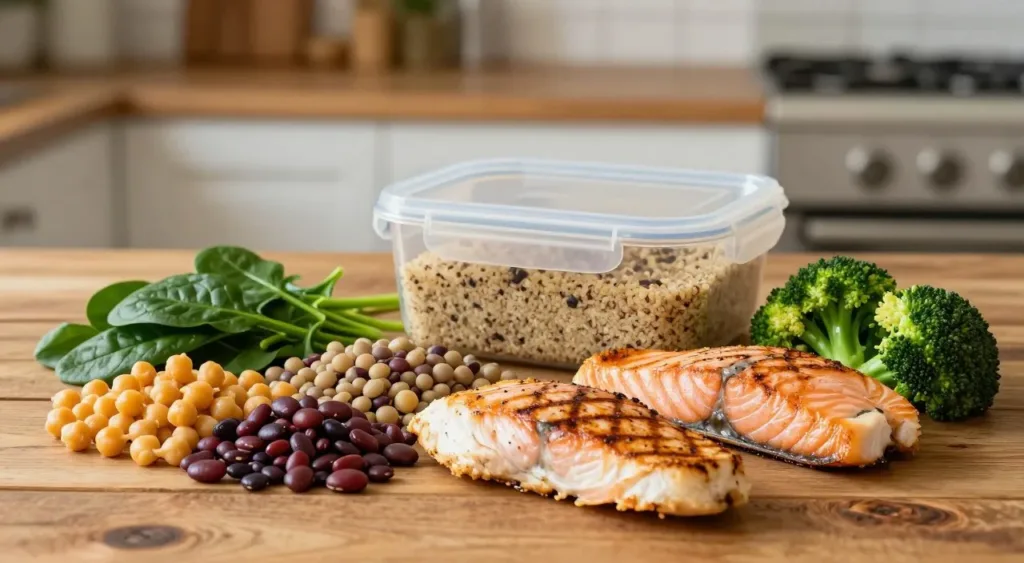
Build your daily protein intake from foods you can eat regularly. Eggs, dairy, poultry, fish, beans, lentils, and tofu all provide options. Distribute servings through the day so each meal contributes, instead of trying to make up the full amount at dinner.
Fatigue, weakness, hair or skin changes, slow wound healing, and frequent illness can each have many causes. They do not diagnose low protein on their own. A restrictive diet may make it harder to meet nutrition needs, but symptoms alone cannot confirm a deficiency. If symptoms or a restrictive diet raise concerns about deficiency, ask a healthcare professional for an assessment.
Build a Resistance Training Plan
Resistance training is the main exercise stimulus for building or preserving muscle during fat loss, and at least two weekly sessions are a useful baseline. Repeatable sessions make it easier to practice movements and track changes. Train major movement patterns consistently and increase the challenge gradually.
An ACSM 2026 overview of 137 systematic reviews involving more than 30,000 participants found that resistance training improved strength, muscle size, power, endurance, contraction velocity, gait speed, balance, and physical function compared with no exercise. The best setup depends on your training aim, available time, and experience.

Set Weekly Frequency and Volume
For a simple weekly baseline, schedule resistance training on at least two days. The ACSM overview found voluntary strength improved with at least two sessions per week. It also found that muscle hypertrophy was enhanced by at least 10 sets per week. A set is one group of repetitions performed before a rest.
| Training aim | Load or volume | Frequency or setup | Key detail |
|---|---|---|---|
| Hypertrophy | At least 10 sets per week | Train major muscles regularly | Eccentric overload enhanced muscle growth |
| Voluntary strength | At least 80% of one-repetition maximum; 2-3 sets | At least 2 sessions per week | Use full range of motion and begin sessions with key exercises |
| Simple weekly baseline | Manageable whole-body work | At least 2 days per week | Leave time to recover between sessions |
A practical plan includes movements that train several muscle groups. Build sessions around these five patterns:
- Squat
- Hinge
- Push
- Pull
- Carry
Choose Loads and Progress Gradually
Both heavier, lower-repetition work and lighter, higher-repetition work can build muscle when sets are challenging and your technique stays sound. For voluntary strength, heavier loads of at least 80 percent of your one-repetition maximum can help. The overview found training to momentary muscle fatigue did not consistently affect outcomes.
Progressive overload means gradually increasing the demand on your muscles, such as adding repetitions or using a heavier weight. A change should preserve good form and fit your current ability. Working out without enough protein can make muscle repair and retention harder, but one low-protein day does not erase progress.
Increase training demands gradually, keeping any weekly weight increase to no more than 10%.
Use Cardio and Recovery to Support Fat Loss
Cardio can complement lifting, but it should not replace the resistance-training stimulus that helps preserve muscle. Choose activity you can repeat, such as walking, cycling, or swimming. Aerobic movement can support health and energy expenditure while strength work remains important for muscle.
A 2026 cohort prescribed aerobic exercise for 150-250 minutes per week or resistance training two to three times per week. Those are different activity approaches, not a requirement to do every form of exercise. Your schedule can combine lifting with cardio if you can recover and train consistently.
Three straightforward ways to add movement include:
- Take a brisk walk outdoors or on a treadmill.
- Ride a stationary or outdoor bicycle at a comfortable pace.
- Try low-impact intervals with movements you can perform safely.
The 3-3-3 rule for losing fat proposes three balanced meals a day, about 1.5-2 liters of water by 3 p.m., and three hours of physical activity per week. It is a simple routine proposal, not a proven fat-loss formula. Its activity time can include different forms of movement, such as walking, cycling, and planned workouts.
Recovery helps you keep activity sustainable. A general sleep target is seven to nine hours per night, though sleep needs and schedules differ. One or two rest days per week are a common option, not a fixed rule for everyone. Work demands, health, fitness, and the intensity of your sessions can change how much rest feels appropriate.
Pay attention to persistent fatigue and declining workout performance rather than adding more activity automatically. Those changes can make consistent training harder if you ignore them. Reduce or rearrange activity if persistent fatigue or declining workout performance makes consistent training difficult.
Turn Nutrition Targets Into a 7-Day Meal Plan
Build each day around a protein source and filling foods you can repeat, rather than treating a sample menu as a prescription. Familiar foods make planning easier and can help you follow your nutrition goals. Use portions that fit your own calorie and protein targets instead of copying another person’s totals.
A 2026 GLP-1 meal-plan page lists daily estimates of 1,370-1,600 calories and 115-140 grams of protein as starting points for that plan. Its Day 1 estimate is about 1,600 calories and 132 grams of protein; Day 2 is about 1,470 calories and 138 grams. Those figures are not universal targets.
Build Meals Around Protein and Produce
Use four practical anchors when you put a meal together: a protein food, produce, a high-fiber carbohydrate, and a source of fat. Examples include chicken, vegetables, brown rice, and olive oil, or beans, greens, whole-wheat toast, and avocado. Swap foods to match your preferences and daily needs.
Two eggs alone are usually not enough protein to meet a full day’s target, though they can contribute to breakfast. A breakfast with three eggs, spinach, mushrooms, bell peppers, whole-wheat toast, and berries is estimated at 26 grams of protein. One serving can fit into a day without having to carry the whole target.
Whether 100 grams of protein is a lot per day depends on your body size and needs; it may be high for one person and low for another. Use a daily target that fits your circumstances, then spread it across meals. Food nutrient values can vary with portions and preparation.
Use a Flexible Seven-Day Rotation
A flexible seven-day meal plan for muscle gain and fat loss can rotate familiar foods rather than rely on a different recipe every day. For breakfast, alternate eggs with whole-wheat toast, oats with Greek yogurt, or Greek yogurt with berries. Add vegetables or fruit when they fit the meal.
For lunches, rotate chicken, beans, and leftovers with vegetables and a whole grain or sweet potato. For dinners, use salmon, chicken, tofu, or beans with vegetables and a starchy side. Snacks can include Greek yogurt, fruit, or another protein food that suits your plan.
Day 1 could pair eggs at breakfast with chicken at lunch and beans at dinner. Day 2 might use oats and Greek yogurt, then salmon and sweet potatoes. Across the remaining days, rotate poultry, fish, beans, lentils, eggs, vegetables, fruit, and whole-wheat toast. Keep portions flexible rather than assigning a calorie total to each day.
USDA FoodData Central is managed by the Agricultural Research Service’s Beltsville Human Nutrition Research Center and hosted by the National Agricultural Library. It provides nutrient values you can use to check foods and portions. Check portions and food nutrient values against your own daily targets, especially when using a plan designed for GLP-1 treatment.
How to Tell Whether Recomposition Is Working
A stable scale reading can still accompany progress if your waist is changing and your training performance is improving. Look for more than one clue because fat loss and muscle gain may not move scale weight in the same direction. Compare the same measures over several weeks, not just from one day to the next.
Signs of gaining muscle and losing fat can include a smaller waist, better strength or more repetitions, and clothes fitting differently. Your scale weight may stay stable during those changes. None of these clues alone proves exactly how much muscle or body fat has changed.
Track More Than Scale Weight
Record four indicators consistently: scale-weight trend, waist measurement, progress photos, and training performance. These measures capture different kinds of change. For example, a stronger lift alongside a smaller waist can be useful context when the scale barely moves.
Use comparable conditions when you measure your waist or take photos. Keep the camera angle, lighting, posture, and clothing similar, and measure your waist at the same place each time. Write down training performance in the same way, such as the weight used and repetitions completed.
Read Changes Over Several Weeks
A single day’s weight or measurement can shift for reasons that do not reflect a lasting change in body composition. Compare trends across several weeks and note whether the measures move together or diverge. Home body-fat readings can fluctuate and are not a diagnosis.
Stable weight with a smaller waist and improving strength can fit recomposition. If only one measure changes, keep observing rather than deciding immediately that the plan has failed. Look for a consistent pattern across at least two measures before deciding whether the plan is working.
Avoid Common Setbacks and Adjust the Plan
Before changing the plan, check whether you followed it consistently and whether your training and recovery have stayed on track. One adjustment at a time makes it easier to learn what is helping. Do not change calories, training volume, and cardio all at once.
Use three checks before changing your approach:
- Review adherence: check whether your eating and training matched the routine you intended.
- Review the calorie estimate: consider whether your starting energy estimate still fits your observed trend.
- Review recovery: check whether poor recovery is disrupting training consistency or performance.
Recomposition can be practical for beginners, adults returning after a break, and people with overweight or obesity. Experienced lifters whose training and nutrition are already well optimized may gain muscle and lose fat more slowly. A slower pace does not automatically mean the plan is ineffective.
If you have a medical condition, are pregnant, have a history of disordered eating, or have questions about medication, seek qualified clinical guidance. Change one adjustable part of the routine at a time so you can tell what helps.
Conclusion
Sustainable recomposition comes from repeating a manageable routine, not from making the largest possible cut. Gradual fat loss alongside muscle-building training is a more useful goal than chasing rapid scale change. Steady choices in nutrition and strength work give you a plan you can judge over time.
Choose one manageable next step before you begin: set a repeatable weekly lifting schedule. Record a starting waist measurement and a strength benchmark, such as the weight and repetitions for a familiar exercise. Choose your first training days and record a baseline measurement before you begin.